Become a MacRumors Supporter for $50/year with no ads, ability to filter front page stories, and private forums.

greenmike

macrumors member
Original poster
Nov 27, 2024
41
25
Assuming that the new Cinebench 2026 offers a better support for efficiency cores, including Apple Silicone chips, it leaves me a little bit baffled given that old CPU's like the 9900K have increased performance of nearly 100% compared to the 14700K for example.

So it looks like that Cinebench 2026 actually handles efficiency cores worse than Cinebench 2024.

I'm quite disappointed because I know from my own experience, comparing 14700K and 14900K to the 9900K in apps that I use, that the score of Cinebench 2024 reliably represented the respective CPUs' performance difference.

The same also applies to my Mac Mini M4 Pro. A much smaller performance gap all of a sudden to older CPUs with less efficiency cores. Dunno what they did but Cinebench 2026 is worse at handling efficiency cores, evidently.

And please don't mention Geekbench being a better benchmark for Macs or I'll eat my hat.
 
A tiny mention of the mini but you opened up about how the differences are impacting intel

What ever, I was trying to be helpful you wanted to just be insulting - I'm out
 
  • Like
Reactions: greenmike
A tiny mention of the mini but you opened up about how the differences are impacting intel

What ever, I was trying to be helpful you wanted to just be insulting - I'm out
Sorry, didn't mean to be rude, I was just a bit cheeky.

I mentioned Intel because I was able to draw a bigger performance gap but this also applies to Apple Silicone.
 
  • Like
Reactions: maflynn
From the article linked to earlier in this thread:

Cinebench 2026 uses the latest version of the Redshift engine that Maxon says ought to be six times harsher on multi-threaded tests compared to the the previous version.

Depending on how Maxon has implemented this, it could explain the perceived differences in results. It's also important to note that scores between different versions of Cinebench are not directly comparable to each other, so comparing 2024 and 2026 scores has no real value.

Whether the systems being tested are running x86 (Intel/AMD) or Apple Silicon (no e) is irrelevant, as the testing methodology is identical across platforms.
 
  • Like
Reactions: Anonymous Freak
From the article linked to earlier in this thread:


Depending on how Maxon has implemented this, it could explain the perceived differences in results. It's also important to note that scores between different versions of Cinebench are not directly comparable to each other, so comparing 2024 and 2026 scores has no real value.

Whether the systems being tested are running x86 (Intel/AMD) or Apple Silicon (no e) is irrelevant, as the testing methodology is identical across platforms.

The aforementioned might be the case but it's very odd that older CPUs all of a sudden perform better. There's some mishap going on with the efficiency cores, 100%.

Newer versions of the engine should harness newer CPUs better and not the other way around.
 
Assuming that the new Cinebench 2026 offers a better support for efficiency cores, including Apple Silicone chips, it leaves me a little bit baffled given that old CPU's like the 9900K have increased performance of nearly 100% compared to the 14700K for example.

So it looks like that Cinebench 2026 actually handles efficiency cores worse than Cinebench 2024.

I'm quite disappointed because I know from my own experience, comparing 14700K and 14900K to the 9900K in apps that I use, that the score of Cinebench 2024 reliably represented the respective CPUs' performance difference.

The same also applies to my Mac Mini M4 Pro. A much smaller performance gap all of a sudden to older CPUs with less efficiency cores. Dunno what they did but Cinebench 2026 is worse at handling efficiency cores, evidently.

And please don't mention Geekbench being a better benchmark for Macs or I'll eat my hat.
Are the numbers from your own testing? Could you provide them? For Apple Silicon, the only older CPUs with fewer efficiency cores than the 4 E-core M4 Pro is the M1 Pro/Max which only had 2 E-cores but increased the frequency of those E-cores to compensate. The M3 Pro meanwhile had 6 E-cores. Doing a quick comparison on cpu monkey between the M3 Pro/Max and M4 Pro does indeed show the M3 catching up to the M4 a little (about 10%). However, even the single threaded test the older CPU improves about 6-7% on the newer test relative to the newer CPU and the number of E-cores does not appear to matter - also I wasn't able to recapitulate your extreme Intel results for the 14900K/9900K*:

ST Ratio CB 26ST Ratio CB 24MT Ratio CB 26MT Ratio CB 24
M4 Pro (14) / M3 Max (14)1.181.251.151.26
M4 Pro (14) / M3 Pro (11)1.191.271.781.98
i9 14900K/9900K1.71.83.253.4


ST Ratio CB 24/26MT Ratio CB 24/26
M4 Pro (14) / M3 Max (14)1.061.1
M4 Pro (14) / M3 Pro (11)1.071.11
i9 14900K/9900K1.061.05

As always there is a few % variation expected due to noise and slight differences in performances between chips of the same type.


*For the 14700K, it may be an issue with that chip in particular (which is very strange):


And whatever that something is, it should have nothing to do with E-cores as the 14900K has more (16 vs 12). Of course it is also possible that it is CPU Monkey's 14900K result that is flawed. CPU monkey has a lot of flawed data on it - I did my best to check what I could (the Mac data seems to be okay above, though I saw other questionable Mac data that I did not include). So if you could supply your data that would be really good. The 285K seems to more or less recapitulate the results from above though again the 14900K seems to catch up to it by about 10% and 9900K catches up to it by about 16% in the newer test.

I'm not sure where CPU-monkey sourced their data from, but another source of user generated data is here:


Though for the PC-users many of these are likely overclocked variants making comparisons difficult.

While on one hand your assertion that older CPUs catch up to newer ones in the newer test seems to be true, it seems to be by a small amount, not a large one - provided the data . Still interesting. Could be that the new test is hitting the FP vector units harder and if those have changed by a smaller amount between the M3 and M4, they'll perform slightly more similarly. I'd have to check other benchmarks to confirm.

EDIT: for what it is worth the ST & MT ratio for the M4/M3 of GB 6's Ray tracer is 1.16 and 1.76 (huge variability in those measures though) and the Blender 4.5 CPU (tricky because they don't explicitly split the Macs by CPU core count for some odd reason in open-data, so you have to look at the distribution and pick the part of the histogram applying to your core count) for M4 Pro (14)/M3 Pro (11) is 1.8 (MT only) so both Blender and GB 6 RT subtest are very similar to CB 26's ratios rather than CB 24's.

 
Last edited:
Are the numbers from your own testing? Could you provide them? For Apple Silicon, the only older CPUs with fewer efficiency cores than the 4 E-core M4 Pro is the M1 Pro/Max which only had 2 E-cores but increased the frequency of those E-cores to compensate. The M3 Pro meanwhile had 6 E-cores. Doing a quick comparison on cpu monkey between the M3 Pro/Max and M4 Pro does indeed show the M3 catching up to the M4 a little (about 10%). However, even the single threaded test the older CPU improves about 6-7% on the newer test relative to the newer CPU and the number of E-cores does not appear to matter - also I wasn't able to recapitulate your extreme Intel results for the 14900K/9900K*:

ST Ratio CB 26ST Ratio CB 24MT Ratio CB 26MT Ratio CB 24
M4 Pro (14) / M3 Max (14)1.181.251.151.26
M4 Pro (14) / M3 Pro (11)1.191.271.781.98
i9 14900K/9900K1.71.83.253.4


ST Ratio CB 24/26MT Ratio CB 24/26
M4 Pro (14) / M3 Max (14)1.061.1
M4 Pro (14) / M3 Pro (11)1.071.11
i9 14900K/9900K1.061.05

As always there is a few % variation expected due to noise and slight differences in performances between chips of the same type.


*For the 14700K, it may be an issue with that chip in particular (which is very strange):


And whatever that something is, it should have nothing to do with E-cores as the 14900K has more (16 vs 12). Of course it is also possible that it is CPU Monkey's 14900K result that is flawed. CPU monkey has a lot of flawed data on it - I did my best to check what I could (the Mac data seems to be okay above, though I saw other questionable Mac data that I did not include). So if you could supply your data that would be really good. The 285K seems to more or less recapitulate the results from above though again the 14900K seems to catch up to it by about 10% and 9900K catches up to it by about 16% in the newer test.

I'm not sure where CPU-monkey sourced their data from, but another source of user generated data is here:


Though for the PC-users many of these are likely overclocked variants making comparisons difficult.

While on one hand your assertion that older CPUs catch up to newer ones in the newer test seems to be true, it seems to be by a small amount, not a large one - provided the data . Still interesting. Could be that the new test is hitting the FP vector units harder and if those have changed by a smaller amount between the M3 and M4, they'll perform slightly more similarly. I'd have to check other benchmarks to confirm.

EDIT: for what it is worth the ST & MT ratio for the M4/M3 of GB 6's Ray tracer is 1.16 and 1.76 (huge variability in those measures though) and the Blender 4.5 CPU (tricky because they don't explicitly split the Macs by CPU core count for some odd reason in open-data, so you have to look at the distribution and pick the part of the histogram applying to your core count) for M4 Pro (14)/M3 Pro (11) is 1.8 (MT only) so both Blender and GB 6 RT subtest are very similar to CB 26's ratios rather than CB 24's.

Numbers are from my testing and also from computerbase to verify my finding:


I don't know which score you used for the 9900K but that's where I noticed this.

I tested my 9900K system because I was about to sell that particular system and ran the new benchmark on the M4 Pro, just to see where it's at now.

Which was roughly 2990 points for the 9900K and 6700 with my M4 Pro.

In Cinebench 2024, I scored 635 points on the 9900K and 1754 points on my 14-Core M4 Pro.

Which means in Cinebench 2024, the M4 Pro scored almost 3 x the performance of the 9900K (2.76 times to be exact).

In Cinebench 2026 the 9900K with 2950 points fits only 2.27 times

That's quite a significant difference. Particularly from a CPU which's architecture was released in 2017.

Something is wrong with the new engine and CPUs with efficiency cores, which is hilarious because they claimed to have now better implemented the latter with 2026.

The 2024 score also made more sense when I first got my M4 Pro and made a performance benchmark in Avid's Pro Tools to compare them.

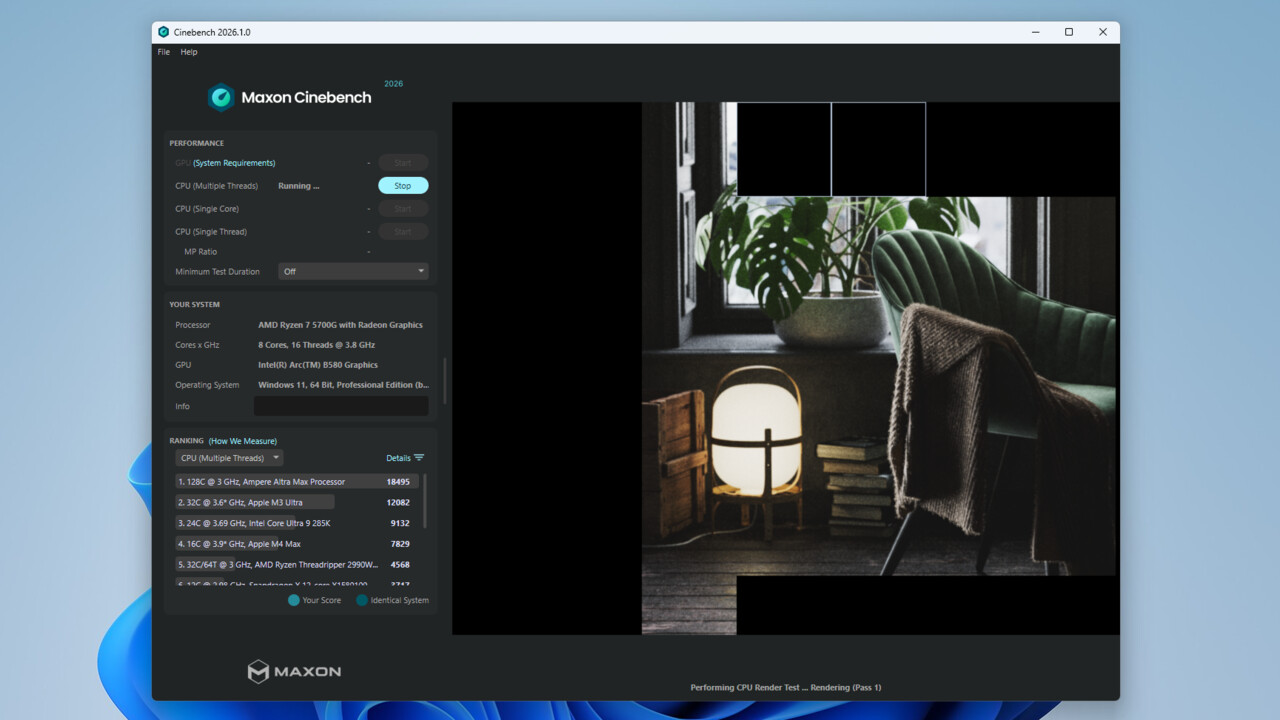
Here's my M4 Pro score:

cb2026.jpg
 
  • Like
Reactions: senttoschool
Numbers are from my testing and also from computerbase to verify my finding:


I don't know which score you used for the 9900K but that's where I noticed this.

I tested my 9900K system because I was about to sell that particular system and ran the new benchmark on the M4 Pro, just to see where it's at now.

Which was roughly 2990 points for the 9900K and 6700 with my M4 Pro.

In Cinebench 2024, I scored 635 points on the 9900K and 1754 points on my 14-Core M4 Pro.

Which means in Cinebench 2024, the M4 Pro scored almost 3 x the performance of the 9900K (2.76 times to be exact).

In Cinebench 2026 the 9900K with 2950 points fits only 2.27 times

That's quite a significant difference. Particularly from a CPU which's architecture was released in 2017.

Something is wrong with the new engine and CPUs with efficiency cores, which is hilarious because they claimed to have now better implemented the latter with 2026.

The 2024 score also made more sense when I first got my M4 Pro and made a performance benchmark in Avid's Pro Tools to compare them.

Here's my M4 Pro score:

View attachment 2596402
The numbers I used were from CPU Monkey - the raw data is in the links I provided above and the 9900K got 640 and 2996 respectively, so similar to the results you quote. Similar scores for the M4 Pro.

It's not efficiency cores. The M3 Pro has more efficiency cores than the M4 Pro and improves on its score relative to the M4 Pro by 11% in the new test compared to the old one (or at least by 7-8%, CPU Monkey's score for the 11 core M3 Pro might be a bit on the low side but regardless the additional E-cores aren't hurting it, the M3 Pro is getting better relative to the M4 not the other way around). Further, there is no difference between the 285K and 9950X3D in CB 24 or 26 - again the E-cores don't seem to be hurting the 285K in CB26. There doesn't appear to be a shift between the M4 and M5 in the two tests.

Basically there seems to be a shift of about 6-8% in favor of x86 in CB26 and additional ~10% gain in favor of older CPUs regardless of E-cores or not.
 
Last edited:
  • Like
Reactions: greenmike
The numbers I used were from CPU Monkey - the raw data is in the links I provided above and the 9900K got 640 and 2996 respectively, so similar to the results you quote. Similar scores for the M4 Pro.

It's not efficiency cores. The M3 Pro has more efficiency cores than the M4 Pro and improves on its score relative to the M4 Pro by 11% in the new test compared to the old one (or at least by 7-8%, CPU Monkey's score for the 11 core M3 Pro might be a bit on the low side but regardless the additional E-cores aren't hurting it, the M3 Pro is getting better relative to the M4 not the other way around). Further, there is no difference between the 285K and 9950X3D in CB 24 or 26 - again the E-cores don't seem to be hurting the 285K in CB26. There doesn't appear to be a shift between the M4 and M5 in the two tests.

Basically there seems to be a shift of about 6-8% in favor of x86 in CB26 and additional ~10% gain in favor of older CPUs regardless of E-cores or not.
I've read through it, yeah seems to be gains for X86 over ARM and generally 10%+ on older CPUs.

Seems to be generally an instruction set bottleneck due to bad implementation on Maxon's side for newer CPUs?

In actual real world tasks, the scores made a lot more sense in Cinebench 2024 because in Pro Tools for example, which fully supports the M4 Pro and the efficiency cores, I was able to duplicate my 9900K benchmark session, which hit the CPU overload, about 2.9 times.
 
  • Like
Reactions: crazy dave
I've read through it, yeah seems to be gains for X86 over ARM and generally 10%+ on older CPUs.

Seems to be generally an instruction set bottleneck due to bad implementation on Maxon's side for newer CPUs?

In actual real world tasks, the scores made a lot more sense in Cinebench 2024 because in Pro Tools for example, which fully supports the M4 Pro and the efficiency cores, I was able to duplicate my 9900K benchmark session, which hit the CPU overload, about 2.9 times.
Don't know ... CB26 isn't boosting SMT or hurting E-cores or that would show up in AMD vs Intel and it doesn't seem to - though one issue is the high variability in x86 results just in general. So to really nail it down we'd need a professional reviewer with access to lots of chips running the test on both of them. We might get something like that when new chips come out at some point this year. Other possibilities are differences in FP vector unit usage. But then the M4 and M5 seem to have the same relationship in 2026 as 2024. So ... yeah ... it's a little odd. Again, hopefully as more chips come out and reviewers start benchmarking them we'll get a better idea of what's happening (though sadly most of the time reviewers do not have a huge amount of older hardware sitting around so it's rare for them to be able to use a new benchmark on an older device which is something we would need to nail down why older chips perform better).

As I said, to be fair Blender 4.5 and GB 6 RT seem to show more similar results in some respects to 2026 than 2024 BUT your mileage will vary. As you said, your apps behaved more similarly to 2024. Just goes to show that individual data points are instructive but not conclusive.
 
  • Like
Reactions: greenmike
Don't know ... CB26 isn't boosting SMT or hurting E-cores or that would show up in AMD vs Intel and it doesn't seem to - though one issue is the high variability in x86 results just in general. So to really nail it down we'd need a professional reviewer with access to lots of chips running the test on both of them. We might get something like that when new chips come out at some point this year. Other possibilities are differences in FP vector unit usage. But then the M4 and M5 seem to have the same relationship in 2026 as 2024. So ... yeah ... it's a little odd. Again, hopefully as more chips come out and reviewers start benchmarking them we'll get a better idea of what's happening (though sadly most of the time reviewers do not have a huge amount of older hardware sitting around so it's rare for them to be able to use a new benchmark on an older device which is something we would need to nail down why older chips perform better).

As I said, to be fair Blender 4.5 and GB 6 RT seem to show more similar results in some respects to 2026 than 2024 BUT your mileage will vary. As you said, your apps behaved more similarly to 2024. Just goes to show that individual data points are instructive but not conclusive.
I mean, generally, you could argue that it might be a driver related issue when in a newer release, an older CPU all of a sudden performs better than the 6 year old newer, technically more advanced counterpart.

It's nothing new, you have it in software all the time but I expected better from Maxon.

I was also as disappointed by Apple and their Logic Pro optimization for their own M-Chips, which is amongst the worst of all DAWs and Avid actually did it properly, which I didn't expect at all and rather excepted them to slack.
 
In Cinebench 2024, I scored 635 points on the 9900K and 1754 points on my 14-Core M4 Pro.

Which means in Cinebench 2024, the M4 Pro scored almost 3 x the performance of the 9900K (2.76 times to be exact).

In Cinebench 2026 the 9900K with 2950 points fits only 2.27 times

That's quite a significant difference. Particularly from a CPU which's architecture was released in 2017.

Something is wrong with the new engine and CPUs with efficiency cores, which is hilarious because they claimed to have now better implemented the latter with 2026.

One issue is that you are assuming that if one benchmark shows a 3x difference, all subsequent updates and revisions should/will also show the same difference. However, that would only be accurate if both the scoring paradigm and benchmark engine remained exactly the same. Maxon did change the engine used in 2026, which will affect the results across all systems. Simply pointing to the performance differential being less with 2026 does not mean that there are any issues, and even Maxon states CB2026 scores cannot be compared to CB2024 scores:

Updated Scoring Methods​

It's crucial to note that Cinebench 2026 scores cannot be compared to those of its predecessor, Cinebench 2024. With the incorporation of the latest Redshift technology and optimized performance, Cinebench 2026 offers a distinctly enhanced and accurate evaluation of modern hardware capabilities.

On that same page, Maxon lists adding support for M4 and M5 Apple Silicon as a feature of CB 2026. So the issue may not be that 2026 has issues handling efficiency cores, but that the prior versions did not properly support M4 series silicon.
 
  • Like
Reactions: greenmike
One issue is that you are assuming that if one benchmark shows a 3x difference, all subsequent updates and revisions should/will also show the same difference. However, that would only be accurate if both the scoring paradigm and benchmark engine remained exactly the same. Maxon did change the engine used in 2026, which will affect the results across all systems. Simply pointing to the performance differential being less with 2026 does not mean that there are any issues, and even Maxon states CB2026 scores cannot be compared to CB2024 scores:

The point of the discussion was not whether something changed, but what changed and how. It's true you can't compare the scores directly between versions, but what you can do is compare the ratio of scores between versions. Again, new version of the benchmark, new engine (and new scene being rendered, not something to be overlooked), thus differences in such ratios are expected, so the question is what changed that older CPUs are suddenly more performant relative to newer ones and why x86 chips got a small boost relative to Apple Silicon in the newest version of the engine? A question only answerable with a lot more data than we have currently (and may not be answerable at all without a deep dive into the internals of each benchmark).

On that same page, Maxon lists adding support for M4 and M5 Apple Silicon as a feature of CB 2026. So the issue may not be that 2026 has issues handling efficiency cores, but that the prior versions did not properly support M4 series silicon.

We've moved past the efficiency core hypothesis. However, the M4 and M5 got worse relative to the M3 in 2026 as compared to 2024 - so arguably the 2024 version handles the M4 and M5 better despite CB26 listing official support while obviously CB24 came out before.
 
  • Like
Reactions: souko and greenmike
The point of the discussion was not whether something changed, but what changed and how. It's true you can't compare the scores directly between versions, but what you can do is compare the ratio of scores between versions. Again, new version of the benchmark, new engine (and new scene being rendered, not something to be overlooked), thus differences in such ratios are expected, so the question is what changed that older CPUs are suddenly more performant relative to newer ones and why x86 chips got a small boost relative to Apple Silicon in the newest version of the engine? A question only answerable with a lot more data than we have currently (and may not be answerable at all without a deep dive into the internals of each benchmark).


We've moved past the efficiency core hypothesis. However, the M4 and M5 got worse relative to the M3 in 2026 as compared to 2024 - so arguably the 2024 version handles the M4 and M5 better despite CB26 listing official support while obviously CB24 came out before.
I fully agree to what you're saying but I think you get what I mean?

It's odd for a CPU that is now officially supported to perform worse than when it wasn't, particularly compared to 8 year old CPUs.

Obviously you can't compare 2 different tests, depending on the content but here, in the case of Cinebench 2024 and 2026, it's the task of rendering (which has not changed) and on top of that the EXACT same scene, which from what it looks like seems to be using all the same materials and rendering properties. I'd probably not make such a scene if they had used a completely different session.

Whatever built-in CPU scheduling by Apple that was used for the M4 Chips in Cinebench 2024 handled tasks more efficiently than Cinebench's now own official implementation in 2026 LOL
 
One issue is that you are assuming that if one benchmark shows a 3x difference, all subsequent updates and revisions should/will also show the same difference. However, that would only be accurate if both the scoring paradigm and benchmark engine remained exactly the same. Maxon did change the engine used in 2026, which will affect the results across all systems. Simply pointing to the performance differential being less with 2026 does not mean that there are any issues, and even Maxon states CB2026 scores cannot be compared to CB2024 scores:


On that same page, Maxon lists adding support for M4 and M5 Apple Silicon as a feature of CB 2026. So the issue may not be that 2026 has issues handling efficiency cores, but that the prior versions did not properly support M4 series silicon.

I bet you that if Maxon would remove their own optimization of the M4/M5 chips from Cinebench 2026 and let them handle tasks the way they did it in 2024, these CPUs would score higher again, which is a shame.
 
I bet you that if Maxon would remove their own optimization of the M4/M5 chips from Cinebench 2026 and let them handle tasks the way they did it in 2024, these CPUs would score higher again, which is a shame.
It's possible they didn't do any special optimization for the M4/M5 - in fact I don't think Apple has even released an optimization guide since the M3 or maybe M4. That's just a list of supported hardware, it does not mean they did anything special to optimize running on the newer cores. It just has to work.

The six times harsher on multithreaded tests claim is interesting though. If it were a question of bandwidth the Macs should've gotten better as Macs tend to have fantastic bandwidth for their CPUs and older x86 CPUs in particular tend to have poor bandwidth. It's possible they changed how much vector processing is happening - poor NEON optimization during ray tracing was a possible problem for CB23. Apple likes to use a larger number of 128b vector units in its cores and if CB26 is more optimized for longer vectors than CB24 that could explain why Intel/AMD catch up a bit. I mean we shouldn't get overboard it's not like CB 23. But it might also explain why the M3 catches up a bit to the M4/M5 as I'm not sure the vector throughput has changed much since the M3 in the E-core or P-core for AS beyond clock speed but @leman or someone else knowledgeable might know for sure - I know at least a couple of generations there were changes but I can't remember which. So other advancements in the CPU cores might matter less if it's hitting the vectors harder.

It could also be changes in the particulars of the scene rather than the engine. While I could make a stronger case for such on the GPU, I can imagine different rendering scenes having different performance characteristics on different CPUs. Basically you'd need to test using the latest version of Redshift more than just the current benchmark scene and time it yourself. Ideally you'd be able to test the CB24 scene as well - and to really nail it down test the current scene on the version of the Redshift engine represented by CB24. I'm not sure how doable any of that is (and to be clear I'm not volunteering).

EDIT: Never mind the above, the scene appears to be the same.
 
Last edited:
Register on MacRumors! This sidebar will go away, and you'll see fewer ads.