I don’t mind the new OS. I appreciate the new features.



As I said before about the overall look - feels like a Linux "skin" from more than a decade ago.Like many of you, I think iPadOS 26 is a significant step back in terms of UX, against the consensus among tech journalists. However, it’s been difficult to articulate exactly why (other than “it feels wrong” and "it goes against fundamental iPad principles"), so I took some time to think specifically about it.
Where we come from
The history of phones and tablets is relatively similar. On the phone side, Symbian and Windows Mobile were still replicating desktop paradigms on a touch screen: small targets, submenus, etc.
View attachment 2590948View attachment 2590949
When it comes to tablets, it was even more obvious, using Windows directly (even if there was a paint layer on top).
View attachment 2590950
Both failed because of multiple reasons. I’ll focus on tablets:
- When the main input is touch, target elements must be bigger.
- Something else, which is less obvious, is that since we don’t have the precision and speed of a mouse, sophisticated actions become frustrating — i.e. it’s slow and hard to adjust a window to the position and size you exactly want.
- Many events that make a desktop experience great (hover, double click, etc.) don’t have an equivalent in a touch interface, or they’re replicated in a very clunky way. For example, you can long-press instead of right-clicking, but it takes more time.
Indirect interfaces just didn't work on touch devices. With the iPhone and iPad, most of those points were solved (I’ll write about a pre-iPadOS 26 world). To start with, sizes of target elements are designed for the precision of a finger.
Windows are always fullscreen, so there are no problems with resizing, and the homescreen is completely independent from the window environment. I launch an app, and it takes over.
Actions are contextual; for example, I don’t have an always-visible menu bar. Instead, if I want to open a bookmark, I will touch the bookmark icon, and I will have the list in there. This goes well with the full-screen interface, because actions are guided: from a logical point of view, it makes more sense and it’s more intuitive than having a menu bar with items that are always there but might not work depending on the situation.
Closing a window doesn’t require hitting a small red light button. In newer versions of iOS/iPadOS, we have the rough action of swipping up, which is much faster, natural and satisfying. Accessing the multitasking interface is also a really nice and well-designed experience. This multitasking interface is also dettached from the app space, and it shows big thumbnails of my recent windows. If I click on one of them, I go back to a full-screen experience.
Overall, these new paradigms make iOS/iPadOS feel like they’re naturally designed for touchscreens. iPhones suceeded against Windows Mobile/Symbian phones, and iPads succeeded against Windows tablets.
What happened over the years
Soon, customers started asking Apple to make iPads more capable, specially when it comes to multitasking. The answer was split-view and slide-over. I don’t think they were perfect solutions (spoiler: I don’t think any multitasking solution on a touch device will be perfect), since discoverability wasn’t good, but they were great. They fit the iPad paradigm: nothing fundamentally changed when it comes to opening, closing and switching windows.
Despite that, over the years, and specially with the introduction of the Magic Keyboard, some people still complained, particularly about the multitasking situation when using a trackpad/mouse. Apple’s answer to this was Stage Manager. With it, they crossed a line and introduced non-fullscreen windows, but still tried to make them touch-friendly, and refused to bring desktop paradigms like traffic lights. I will not focus on Stage Manager too much, but I think it’s clear that it was not a good solution.
However, some people, instead of realizing that bringing a desktop interface to a touch device is just a bad idea, doubled down on the bet and asked Apple to “stop trying strange things, the windowed interface is a solved issue on desktop” or just “bring macOS to the iPad”. So here we are, with iPadOS 26.
We’ll come to that in a second, but first of all, some comments about making iPads more capable:
- I do think there is some room to make iPads more capable in an iPad way. That means, thinking about ways the touch interface can be even better than the desktop equivalent, or finding new uses cases where an iPad is better than a Mac. In any case, I think “if we don’t find a way, just let’s make it a Mac-like product” is a non-answer.
- There will be some use cases where, no matter how hard Apple tries, an iPad will be always worse than a Mac. An iPad will be always less capable for video editing than a Mac (not just because of UX, but due to other factors). Which doesn’t mean the iPad doesn’t have its place in video editing.
iPadOS 26
With iPadOS 26, Apple crossed another line: they’re not just introducing a windowed interface, but it’s designed as pointer-first. However, they needed to also make it compatible for touch, so it’s not good for either case.
Menu bar
As explained before, I think a menu bar doesn’t have its place in iPadOS, were elements are contextual and workflows are guided. It’s like giving up on making a logical interface. Also, it interferes with other actions, like bringing down the notification center. Clicking on a menu item, holding and releasing on a submenu item feels natural and quick on a Mac, but not on an iPad, because it takes more time to move your finger, and you’re visually blocking the selection with it. Finally, it’s not so easy to define an active window on a touch device, so it’s less obvious to know to which app the menu is referring.
Window system
Traffic lights are too small to touch, so we need two actions: one in order to expand them, and another to touch the specific item. Even then, they’re too close to each other, so it’s error-prone. Compare that to swipping up.
Resizing is always very weird, with a necessary strange rendering (compare that do a Mac). And, as mentioned before, it’s not easy to do that with fingers. There are some complicated gestures that are difficult to get right, like swipping up a window for fullscreen or swipping right/left for Split View.
But, to me, the worst of all is how it complicates the iPad experience. Let’s say I open Safari. By default, it’s fullscreen, but I make it smaller. I have to swipe up from the bottom in order to go to the homescreen, and by doing that I see my apps, with the Safari window minimized on the right side. I open settings, once again, in fullscreen. But if I swipe up, since it was fullscreen, it’s not minimized together with Safari. If I had made it smaller, then it would be. ????
When I access the multitasking interface, there is a mix of fullscreen and non-fullscreen windows, on separate sections. If I open a new Safari window, depending on how I do it, it might end up on the fullscreen or non-fullscreen section.
After a lot of thought, more or less I understand all edge cases, but think of it: from a user point of view, this is a mess. I don’t know what happens when I swipe up. I don’t know if there’s a difference between swiping up, touching the red light, or touching the yellow light. I don’t know what happens if I switch modes, etc. There’s no way to make this system predictable.
The iPad’s biggest strength was how predictable it was.
“But the iPad can be also used with a keyboard”
In my previous point, I was always talking about the touch experience. And it’s nice that you can use a keyboard and mouse, but it’s not the primary input of the device, and it shouldn’t constrain the touch experience. I find the vision of an iPad “always attached to a Magic Keyboard” very limited. In that case, why don’t you use a Mac, which is designed from the ground up for mouse input? It’s a sub-par experience.
There are other suggestions, like creating separate interfaces for keyboard/mouse mode (like classic macOS, with windows in the dock) and standalone mode (like a classic iPad). Unfortunately, I think this would be worse:
Then, there are wilder suggestions, like dual-booting macOS, which would be worst solution for multiple reasons (the fact of rebooting, partitions, etc.).
- The transition between states is not easy. For example, how would you transfer pairs of tablet split-view windows into the desktop interface? Just throw them in there as independent windows? But then, there will be not enough space and there could be many windows on top of each other. And let’s not even think about how to adapt individual apps.
- Some developers might create their apps taking into account the precision of desktop mode. And, as said before, we want to keep the iPad touch-first. At least, with the current implementation, the app remains the same.
Conclusion
I don’t want to dismiss the desires of people who ask for a big iPad change, but I think 99% of them wouldn’t be happy in reality with what they want. It’s easy to imagine a thin and light iPad with macOS in abstract, but it’s like picturing a motorbike with 1000 kgs of luggage, and thinking it would still feel like a motorbike.
Some people argue that the iPad Pro can be more expensive than a Mac, so it should be as capable as a Mac. However, bringing this comparison to the extreme: an Apple Watch Ultra is more expensive than a Mac mini. There are many things a Mac can do that an Apple Watch can’t or does worse, but also the other way around! It’s the same with the iPad.
There’s also a factor when it comes to the mix of users and use cases. Some users will be able (and will be happy) to use an iPad for everything. Another group will be doing just some tasks on the iPad. And another group will not like “the iPad way” of doing things at all, or it won’t cover any of their use cases.
For example, I’ve read John Gruber criticism of the iPad, and it seems clear that he’s not its target audience, regardless of whether he can accomplish some tasks on the iPad or not. He’s very used to indirect interfaces. Same with others like SnazzyLabs, Federico Viticci…
I have an iPad Pro, and it’s by far my favorite Apple device. Because of the hardware, but specially because of the software. Of course, I still need my Mac (in fact, most of the time), but for all creative tasks, like researching, brainstorming, quick edits, etc. I prefer the iPad. And the premium price of a Pro over a standard version is well worth it.
So it’s striking to hear media like The Verge journalists, whom you’d presume to know more than the average person about the tech industry, diminishing the iPad, when (also because of price, sure) it outsells the Mac by a large margin, with very high customer satisfaction levels. I think the iPad is a very ambitious product, and I don't understand how a tech enthusiast would like to turn it into a bad MacBook. Specially, given that the concept of a tablet as a traditional computer has failed over and over again.

Well...this may be true for desktop computers which are optimized to deliver very high computing power for the best performance on high-demanding, time-sensitive tasks.[...] There will be some use cases where, no matter how hard Apple tries, an iPad will be always worse than a Mac. [...]
I don’t believe this will happen, I feel like if tablets were to have replaced laptops it would have happened years ago.Very intelligent post...thanks a lot for taking the time to write this down and share it with us, AlexESP. 👍
I think you've hit the nail on the head here in many aspects. In my opinion, the weaknesses of the iPadOS 26 multitasking concept you mentioned are accurately described.
Nevertheless, I do not agree with the main conclusion.
I'm also a fan and power user of the multitasking concept in earlier iPadOS versions, but this concept also needed some time to become better and better over time (while still being imperfect now). My bet is that the same will happen with this new concept as the next step - it still has quite some rough edges and bugs now, but I see absolutely no fundamental obstacles that could prevent it from improving to the level of MacBooks. Yes, it will still take some time, but in general I see absolutely no reason why the Tablet concept will not replace and surpass the Laptop concept completely and entirely.
To put this belief in simple terms: adding display touch as an input channel doesn't take away anything, but adds a lot, while there are no limitations on software or hardware side which could limit a Tablet from becoming as capable as a Laptop.
Well...this may be true for desktop computers which are optimized to deliver very high computing power for the best performance on high-demanding, time-sensitive tasks.
But, as I said, my guess would be that Tablets will be more than capable of replacing Laptops in the future. I just don't perceive any "failure" of a tablet not being usable as a full blown computer, just some shortcoming which need further improvement. Even my old iPad Pro 9.7" from 2016 was already extremely capable of serving as a Laptop substitute. When I extrapolate what my current iPad Pro M4 13" can already do today, I am more than convinced that Laptops will become obsolete earlier or later - starting with the MacBook Air Series as the first casualty, continuing with the more powerful MacBook series....


Like many of you, I think iPadOS 26 is a significant step back in terms of UX, against the consensus among tech journalists. However, it’s been difficult to articulate exactly why (other than “it feels wrong” and "it goes against fundamental iPad principles"), so I took some time to think specifically about it.
Where we come from
The history of phones and tablets is relatively similar. On the phone side, Symbian and Windows Mobile were still replicating desktop paradigms on a touch screen: small targets, submenus, etc.
View attachment 2590948View attachment 2590949
When it comes to tablets, it was even more obvious, using Windows directly (even if there was a paint layer on top).
View attachment 2590950
Both failed because of multiple reasons. I’ll focus on tablets:
- When the main input is touch, target elements must be bigger.
- Something else, which is less obvious, is that since we don’t have the precision and speed of a mouse, sophisticated actions become frustrating — i.e. it’s slow and hard to adjust a window to the position and size you exactly want.
- Many events that make a desktop experience great (hover, double click, etc.) don’t have an equivalent in a touch interface, or they’re replicated in a very clunky way. For example, you can long-press instead of right-clicking, but it takes more time.
Indirect interfaces just didn't work on touch devices. With the iPhone and iPad, most of those points were solved (I’ll write about a pre-iPadOS 26 world). To start with, sizes of target elements are designed for the precision of a finger.
Windows are always fullscreen, so there are no problems with resizing, and the homescreen is completely independent from the window environment. I launch an app, and it takes over.
Actions are contextual; for example, I don’t have an always-visible menu bar. Instead, if I want to open a bookmark, I will touch the bookmark icon, and I will have the list in there. This goes well with the full-screen interface, because actions are guided: from a logical point of view, it makes more sense and it’s more intuitive than having a menu bar with items that are always there but might not work depending on the situation.
Closing a window doesn’t require hitting a small red light button. In newer versions of iOS/iPadOS, we have the rough action of swipping up, which is much faster, natural and satisfying. Accessing the multitasking interface is also a really nice and well-designed experience. This multitasking interface is also dettached from the app space, and it shows big thumbnails of my recent windows. If I click on one of them, I go back to a full-screen experience.
Overall, these new paradigms make iOS/iPadOS feel like they’re naturally designed for touchscreens. iPhones suceeded against Windows Mobile/Symbian phones, and iPads succeeded against Windows tablets.
What happened over the years
Soon, customers started asking Apple to make iPads more capable, specially when it comes to multitasking. The answer was split-view and slide-over. I don’t think they were perfect solutions (spoiler: I don’t think any multitasking solution on a touch device will be perfect), since discoverability wasn’t good, but they were great. They fit the iPad paradigm: nothing fundamentally changed when it comes to opening, closing and switching windows.
Despite that, over the years, and specially with the introduction of the Magic Keyboard, some people still complained, particularly about the multitasking situation when using a trackpad/mouse. Apple’s answer to this was Stage Manager. With it, they crossed a line and introduced non-fullscreen windows, but still tried to make them touch-friendly, and refused to bring desktop paradigms like traffic lights. I will not focus on Stage Manager too much, but I think it’s clear that it was not a good solution.
However, some people, instead of realizing that bringing a desktop interface to a touch device is just a bad idea, doubled down on the bet and asked Apple to “stop trying strange things, the windowed interface is a solved issue on desktop” or just “bring macOS to the iPad”. So here we are, with iPadOS 26.
We’ll come to that in a second, but first of all, some comments about making iPads more capable:
- I do think there is some room to make iPads more capable in an iPad way. That means, thinking about ways the touch interface can be even better than the desktop equivalent, or finding new uses cases where an iPad is better than a Mac. In any case, I think “if we don’t find a way, just let’s make it a Mac-like product” is a non-answer.
- There will be some use cases where, no matter how hard Apple tries, an iPad will be always worse than a Mac. An iPad will be always less capable for video editing than a Mac (not just because of UX, but due to other factors). Which doesn’t mean the iPad doesn’t have its place in video editing.
iPadOS 26
With iPadOS 26, Apple crossed another line: they’re not just introducing a windowed interface, but it’s designed as pointer-first. However, they needed to also make it compatible for touch, so it’s not good for either case.
Menu bar
As explained before, I think a menu bar doesn’t have its place in iPadOS, were elements are contextual and workflows are guided. It’s like giving up on making a logical interface. Also, it interferes with other actions, like bringing down the notification center. Clicking on a menu item, holding and releasing on a submenu item feels natural and quick on a Mac, but not on an iPad, because it takes more time to move your finger, and you’re visually blocking the selection with it. Finally, it’s not so easy to define an active window on a touch device, so it’s less obvious to know to which app the menu is referring.
Window system
Traffic lights are too small to touch, so we need two actions: one in order to expand them, and another to touch the specific item. Even then, they’re too close to each other, so it’s error-prone. Compare that to swipping up.
Resizing is always very weird, with a necessary strange rendering (compare that do a Mac). And, as mentioned before, it’s not easy to do that with fingers. There are some complicated gestures that are difficult to get right, like swipping up a window for fullscreen or swipping right/left for Split View.
But, to me, the worst of all is how it complicates the iPad experience. Let’s say I open Safari. By default, it’s fullscreen, but I make it smaller. I have to swipe up from the bottom in order to go to the homescreen, and by doing that I see my apps, with the Safari window minimized on the right side. I open settings, once again, in fullscreen. But if I swipe up, since it was fullscreen, it’s not minimized together with Safari. If I had made it smaller, then it would be. ????
When I access the multitasking interface, there is a mix of fullscreen and non-fullscreen windows, on separate sections. If I open a new Safari window, depending on how I do it, it might end up on the fullscreen or non-fullscreen section.
After a lot of thought, more or less I understand all edge cases, but think of it: from a user point of view, this is a mess. I don’t know what happens when I swipe up. I don’t know if there’s a difference between swiping up, touching the red light, or touching the yellow light. I don’t know what happens if I switch modes, etc. There’s no way to make this system predictable.
The iPad’s biggest strength was how predictable it was.
“But the iPad can be also used with a keyboard”
In my previous point, I was always talking about the touch experience. And it’s nice that you can use a keyboard and mouse, but it’s not the primary input of the device, and it shouldn’t constrain the touch experience. I find the vision of an iPad “always attached to a Magic Keyboard” very limited. In that case, why don’t you use a Mac, which is designed from the ground up for mouse input? It’s a sub-par experience.
There are other suggestions, like creating separate interfaces for keyboard/mouse mode (like classic macOS, with windows in the dock) and standalone mode (like a classic iPad). Unfortunately, I think this would be worse:
Then, there are wilder suggestions, like dual-booting macOS, which would be worst solution for multiple reasons (the fact of rebooting, partitions, etc.).
- The transition between states is not easy. For example, how would you transfer pairs of tablet split-view windows into the desktop interface? Just throw them in there as independent windows? But then, there will be not enough space and there could be many windows on top of each other. And let’s not even think about how to adapt individual apps.
- Some developers might create their apps taking into account the precision of desktop mode. And, as said before, we want to keep the iPad touch-first. At least, with the current implementation, the app remains the same.
Conclusion
I don’t want to dismiss the desires of people who ask for a big iPad change, but I think 99% of them wouldn’t be happy in reality with what they want. It’s easy to imagine a thin and light iPad with macOS in abstract, but it’s like picturing a motorbike with 1000 kgs of luggage, and thinking it would still feel like a motorbike.
Some people argue that the iPad Pro can be more expensive than a Mac, so it should be as capable as a Mac. However, bringing this comparison to the extreme: an Apple Watch Ultra is more expensive than a Mac mini. There are many things a Mac can do that an Apple Watch can’t or does worse, but also the other way around! It’s the same with the iPad.
There’s also a factor when it comes to the mix of users and use cases. Some users will be able (and will be happy) to use an iPad for everything. Another group will be doing just some tasks on the iPad. And another group will not like “the iPad way” of doing things at all, or it won’t cover any of their use cases.
For example, I’ve read John Gruber criticism of the iPad, and it seems clear that he’s not its target audience, regardless of whether he can accomplish some tasks on the iPad or not. He’s very used to indirect interfaces. Same with others like SnazzyLabs, Federico Viticci…
I have an iPad Pro, and it’s by far my favorite Apple device. Because of the hardware, but specially because of the software. Of course, I still need my Mac (in fact, most of the time), but for all creative tasks, like researching, brainstorming, quick edits, etc. I prefer the iPad. And the premium price of a Pro over a standard version is well worth it.
So it’s striking to hear media like The Verge journalists, whom you’d presume to know more than the average person about the tech industry, diminishing the iPad, when (also because of price, sure) it outsells the Mac by a large margin, with very high customer satisfaction levels. I think the iPad is a very ambitious product, and I don't understand how a tech enthusiast would like to turn it into a bad MacBook. Specially, given that the concept of a tablet as a traditional computer has failed over and over again.


While that would be great for us, consumers, and with just one device most of us would have all our computing needs covered, that would be financially a disaster for Apple Inc.What a dream to have an iPhone that when docked loaded into macOS and then undocked when back to iOS. Same for iPad.
That’s the issue. I’d gladly try the new windowed UI with my 11” iPad Pro connected to an external monitor, but I want to be able to switch to the old iPadOS 18 UI when i use it as a tablet.If they had just left the Split View and slide over options with the full screen mode I’d have no complaints. If people want windows for whatever reason on a tablet let them have it but taking away features is aggravating.
It would financially be a disaster because it wouldn’t sell enough to be profitable.While that would be great for us, consumers, and with just one device most of us would have all our computing needs covered, that would be financially a disaster for Apple Inc.
Imagine, suddenly all your customers can replace three devices with just one: their new iPhone. Nah, Apple wants to continue selling you an iPhone, an iPad and a Mac every 2-4-8 years.
 No one has created a device with that description that has gone on to gain mass market approval worldwide. I don’t doubt there’s folks that want it, there’s just not enough of them to be worth anyone’s while to market to.
I doubt it will be a different story for you because, in a few years time, there will simply be a few more years of additional unintuitive changes on top of the current unintuitive changes. Hopefully, there’s another enjoyable product for you out there.I agree with this completely. I've actually decided to sell my iPad Pro, since iPadOS 26 I just no longer have the same enjoyment from the product anymore, and rather frustration. While I'm glad others are finding a postive change, things are less intuitive for me and this expands across to iOS too. I'm sure it will be a different story in a few years time, but for now the path Apple has taken has dissapointed me.
I actually think one point of the changes was to make it so that full screen users wouldn’t accidentally find themselves in a mode they’re not familiar with. They DID say that most iPad users are full screen users.I think it’s a step forwards. It makes the ipad far more usable as a small form factor laptop and as far as the touch UI goes, i have lost nothing that i ever used.
The extra windowing features can mostly be ignored and likely will be by most users who don’t know about them.

Most ipad users are full screen users yes. Unless you hook up to a decent sized external display. That changes things.I actually think one point of the changes was to make it so that full screen users wouldn’t accidentally find themselves in a mode they’re not familiar with. They DID say that most iPad users are full screen users.

I realize the following suggestion is nothing like your dream but, remoting into a Mac with your iPad is the closest we are going to get for several more years, in my opinion.I don't mind it. Just got my first "windowing capable" iPad Air M3 a week ago. But it still has many limitations. Like especially when attached to a monitor. I cannot open the same instance of the same app, or a new window within the app.
I'm not sure if this is a feature that devs must implement, but If open one VNC remote window and I just cannot open another one, unless its a different VNC app, which is stupid.
But I was quite blown away that it works hooked up to a 49" Dell monitor via USB-C and keyboard/mouse is passed thru no problem, and native resolution of 5120x1440. But all the UI elements are huge, there is no scaling or sizing unfortunately.
But this is the absolutely the best attempt at trying to be more than a web/media consumption device.
I still wish it could be some kind of true hybrid running macOS when attached to a monitor. That would be a killer feature and I wouldn't hesitate to blow a wad of money on a souped up version.
I don't mind it. Just got my first "windowing capable" iPad Air M3 a week ago. But it still has many limitations. Like especially when attached to a monitor. I cannot open the same instance of the same app, or a new window within the app.
I'm not sure if this is a feature that devs must implement, but If open one VNC remote window and I just cannot open another one, unless its a different VNC app, which is stupid.
But I was quite blown away that it works hooked up to a 49" Dell monitor via USB-C and keyboard/mouse is passed thru no problem, and native resolution of 5120x1440. But all the UI elements are huge, there is no scaling or sizing unfortunately.
But this is the absolutely the best attempt at trying to be more than a web/media consumption device.
I still wish it could be some kind of true hybrid running macOS when attached to a monitor. That would be a killer feature and I wouldn't hesitate to blow a wad of money on a souped up version.
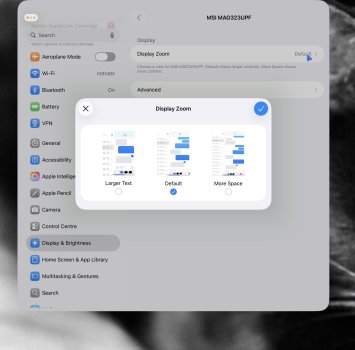
You can alter the display scaling in settings I thoughtI don't mind it. Just got my first "windowing capable" iPad Air M3 a week ago. But it still has many limitations. Like especially when attached to a monitor. I cannot open the same instance of the same app, or a new window within the app.
I'm not sure if this is a feature that devs must implement, but If open one VNC remote window and I just cannot open another one, unless its a different VNC app, which is stupid.
But I was quite blown away that it works hooked up to a 49" Dell monitor via USB-C and keyboard/mouse is passed thru no problem, and native resolution of 5120x1440. But all the UI elements are huge, there is no scaling or sizing unfortunately.
But this is the absolutely the best attempt at trying to be more than a web/media consumption device.
I still wish it could be some kind of true hybrid running macOS when attached to a monitor. That would be a killer feature and I wouldn't hesitate to blow a wad of money on a souped up version.
Confirming:You can alter the display scaling in settings I thought

Apparently not in all installations. Not on 9th gen, 26.3.Confirming: