Become a MacRumors Supporter for $50/year with no ads, ability to filter front page stories, and private forums.
You are forgetting the system data. It does make using an iPad Pro with 128 gb challenging. Again hopefully this is just a bug with the first beta but again its taking up more than half the space of the iPad.

View attachment 2639670
View attachment 2639671

There must be something wrong, cuz I see waaay less utilized data on mine.
Still, even on my iPad, I don't get it: what the heck is system data? Why is it so huge?
 
There must be something wrong, cuz I see waaay less utilized data on mine.
Still, even on my iPad, I don't get it: what the heck is system data? Why is it so huge?
IMG_6607.jpeg


I’m not sure because it’s consistent on my devices on ios27 but again it’s the first beta. This is on an 15 pro max 256gb. On the iPad Pro with 128 it is a disaster. The same with with wife’s iPad mini 7 with Apple Intelligence, like just a few gigs of data left open.
 
I have the Mini 7 with basically one app: Books.

I have two 13" Pros, but the Mini makes the best ereader and, for me, is much better than any Kindle. Using the Calibre app I can load any eBook into the Books app and keep everything in the Apple ecosystem--which is my preference.
Reading is also the primary use case for my iPad mini. It began years ago as a Kindle replacement, then became even more useful after I discovered Calibre. It’s a stellar reading experience.
 
My Z Fold 7 has completely replaced my tablet usage. I don't see myself buying an iPad in the near future, and I really have to decide if the Ultra is worth the cost.
 
  • Like
Reactions: zenmacx
My Z Fold 7 has completely replaced my tablet usage. I don't see myself buying an iPad in the near future, and I really have to decide if the Ultra is worth the cost.
My Z Fold7 completely changed my opinion on foldables. It’s been a fantastic experience and fueled my desire for a folding iPhone.

Then Apple dashed that enthusiasm by choosing an ugly squat short and wide shape, which for me is unusable. It’s overall size unfolded is smaller than my Z and the odd shape kills it’s use for the type of work I do.

Samsung, OnePlus, Oppo, Huawei and others all use the same folding form factor, but Apple chose to be different in an odd yet not surprising way.

Knowing the influence the Cupertino company has, Samsung is making that same thing so as to offer choices to it’s customers. The outcome will be interesting.

It will be fascinating to see how it all plays out, as Apple has a massive base of customers who believe the company can do no wrong and knows what’s best for them.
 
  • Like
Reactions: pdaholic
My Z Fold7 completely changed my opinion on foldables. It’s been a fantastic experience and fueled my desire for a folding iPhone.

Then Apple dashed that enthusiasm by choosing an ugly squat short and wide shape, which for me is unusable. It’s overall size unfolded is smaller than my Z and the odd shape kills it’s use for the type of work I do.

Samsung, OnePlus, Oppo, Huawei and others all use the same folding form factor, but Apple chose to be different in an odd yet not surprising way.

Knowing the influence the Cupertino company has, Samsung is making that same thing so as to offer choices to it’s customers. The outcome will be interesting.

It will be fascinating to see how it all plays out, as Apple has a massive base of customers who believe the company can do no wrong and knows what’s best for them.
I couldn't agree more! The Fold 7 size is perfect for a video on the top and a browser window or pdf on the bottom. Won't get that with the short, squat Ultra. I wouldn't even consider it if my family wasn't so stuck on iMessages and FaceTime. I'm using an iPhone with the Fold 7 just for that reason.
 
  • Like
Reactions: zenmacx
I feel like this is the dark horse of the lineup for 2026. This thing sounds sick, especially if they can fit a larger display in with a bezel shrink. Don't mind that as much on the mini since it's fairly easy to hold. If it gets bumped to A20 Pro that would be even crazier, especially for battery life or weight reduction if they go that route to just make it this ultra-light device. I'd even take reducing the bezels with no change in screen size, just making it physically smaller. I imagine this thing is at least going up $200 though, lol, which may cause them to introduce a more basic model.

I have no idea what they would call this. I feel like iPad Air mini doesn't make sense as it has upgrades to OLED (unless the Air gets that) but then again it's not like going to be noticeably thinner or lighter than the regular iPad mini. I guess you could make a case to call it the iPad mini Pro, or since it uses a Pro chip, even if it doesn't match the M series Pro chips, which then get shared down to the Air the next year. Their whole naming scheme needs a top-to-bottom rework under Ternus. Talking product names, chip names, everything. It's really confusing for normies and obnoxious for us. Apple used to adhere to the paradox of choice principle when it came to simple product categories, but now they're all-in on the price ladders, and I guess it is working for them. That's fine, I suppose, but update the names!
 
One of three Apple devices I'm waiting for...
I want to upgrade my Mini 6 and the 7 didn't provide any compelling reasons to do so.

I'm also in need of an Apple TV update for least one unit since I'm still sitting on the original HD models which aren't getting the new tvOS, and I'm interested in the home hub since I use HomeKit for all of my smart home automations. I hope all of this stuff gets announced in September!
 
I keep mine until they can no longer be updated.
This is my take as well.

My current mini is so enjoyable out of all the apple devices I have that there's no reason to upgrade. Oh sure Apple is the master of creating FOMO... but I will pass.


According to the latest rumors, Apple is close to launching its next-generation iPad mini. So what should we expect from the successor to the iPad mini 7 that Apple released over 20 months ago. Read on to find out.

ipad-mini-7-feature-blue.jpg

Processor and Performance

Apple is working on a next-generation version of the iPad mini (codename J510/J511) that features the A19 Pro chip, according to information found in code that Apple mistakenly shared in August.

Apple's A19 Pro chip since debuted in the iPhone Air and iPhone 17 Pro models. The iPhone 17 Pro models include the higher-end version of Apple's A19 Pro chip with a 6-core CPU and a 6-core GPU, while the iPhone Air uses a mid-tier A19 Pro chip with one fewer GPU core than the A19 Pro chip used in the iPhone 17 Pro and Pro Max.

If the code leak is accurate for the iPad mini 8, Apple is likely to use the mid-tier A19 Pro chip found in the iPhone Air. This is based on the fact that the A17 Pro chip used in the iPad mini 7 has a 6-core CPU with two high-performance cores and four efficiency cores, along with a 5-core GPU, compared to the 6-core GPU found on the A17 Pro used in the iPhone 15 Pro.

Apple built the A19 Pro chip on an upgraded third-generation 3-nanometer N3P process for modest speed and efficiency improvements. The chip includes a 16-core Neural Engine, next-generation dynamic caching, and unified image compression.

The GPU in the A19 Pro has an upgraded architecture with a larger cache, more memory, and Neural Accelerators that are built into each core. Apple says that this change provides 3× the peak GPU compute over the prior-generation chip. There's also an upgraded 16-core Neural Engine for AI tasks.

There is an outside chance that Apple opts for the A20 Pro chip for the new iPad mini. The claim has been made by a MacRumors tipster who analyzed a macOS kernel debug kit containing internal Apple codenames. However, the iPad mini has not always received Apple's newest A-series chip at the time it was updated, so the A19 Pro cannot be ruled out at this time. iPhone 18 Pro models are also expected to use the A20 Pro chip, which will reportedly be fabricated with TSMC's advanced 2nm process.

Display

ipad-mini-7-1.jpg

Apple's plan to transition the ‌‌iPad mini‌‌ from an LCD to an OLED display is widely rumored. According to Bloomberg's Mark Gurman, the small form-factor tablet is likely to be the next Apple device to adopt OLED. According to a Chinese leaker with sources in Apple's supply chain, Apple has evaluated a Samsung-made OLED display for its next iPad mini model.

It remains unclear whether the iPad mini 8 will feature a higher refresh rate than the 60Hz LCD display used in the existing iPad mini 7, but since the new base iPhone 17 now uses a 120Hz ProMotion panel, it would be reasonable to expect the same on the first OLED iPad mini. A separate report has suggested the ‌‌‌iPad mini 8‌‌‌'s screen could increase in size from 8.3 inches to 8.7 inches with the adoption of OLED.

OLED panels can individually control each pixel, resulting in more precise color reproduction and deeper blacks compared to other common display technologies. They also provide superior contrast, faster response times, better viewing angles, and greater design flexibility. All of Apple's flagship iPhones use OLED panels, and in May 2024 the company brought the display technology to the iPad Pro for the first time.

Unlike Apple's ‌iPad Pro‌ models, which feature two-stack low-temperature polycrystalline oxide (LTPO) OLED panels‌, the ‌iPad mini‌ may have a single-stack low-temperature polycrystalline silicon (LTPS) panel, which would make it dimmer.

Chassis Design

ifixit-ipad-mini-teardown.jpg

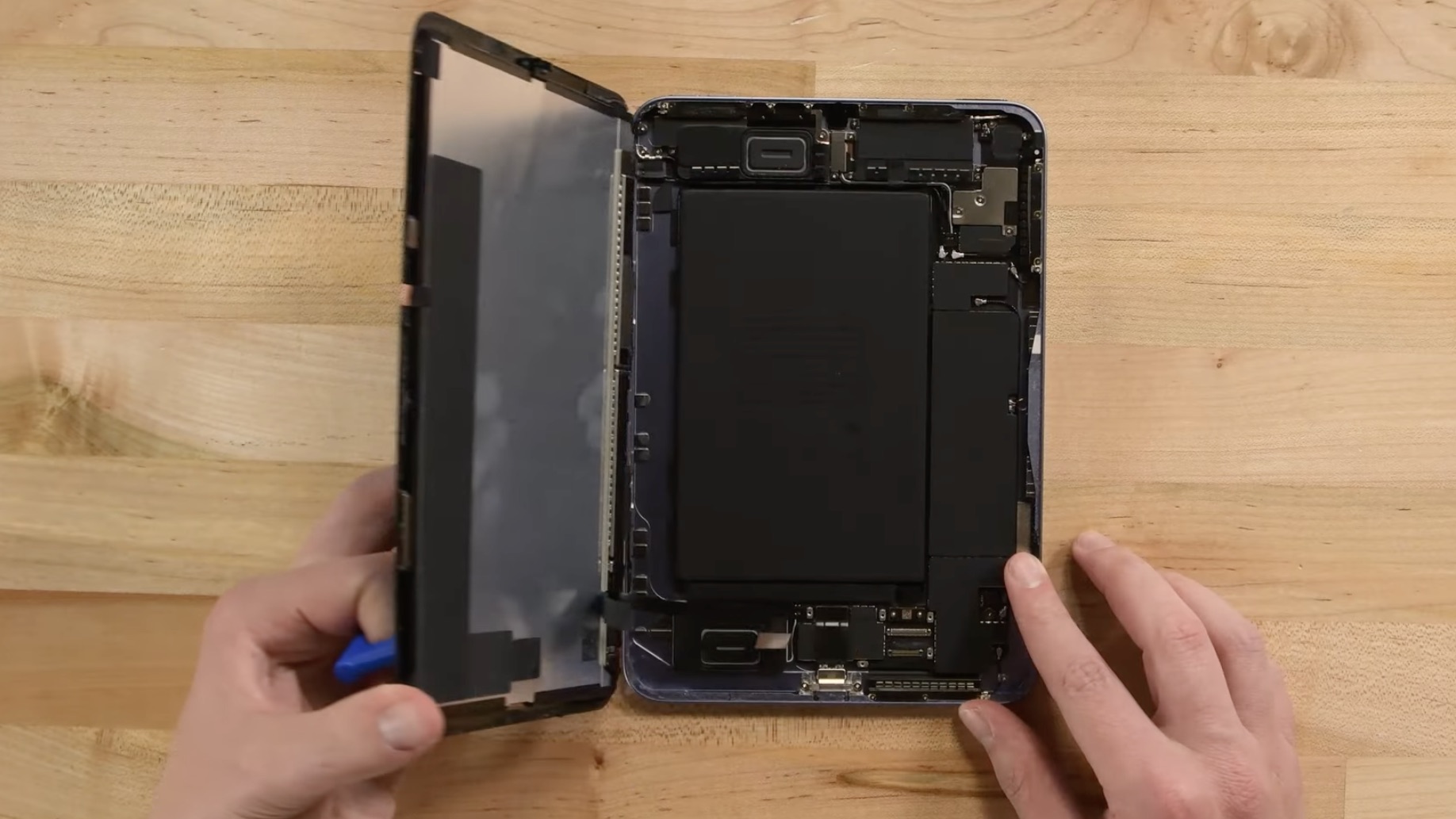
Apple is reportedly working to give the iPad mini 8 a more water-resistant design, according to Bloomberg's Mark Gurman. The updated casing would bring protection levels closer to those of the iPhone, making the tablet safer for use in damp environments.

To achieve this, Apple is said to have designed a new vibration-based speaker system that eliminates the need for traditional speaker holes. By using sound-emitting surfaces instead of open grilles, the company can reduce potential entry points for water and dust, resulting in a more sealed, durable enclosure.

On the iPhone, Apple relies on adhesives and gaskets to shield speakers and other openings from moisture. The iPad mini's approach appears to go further, doing away with the holes altogether. Current iPad mini models lack any official IP rating, but the upcoming version could mark the first in the lineup to feature a certified level of water protection.

Apple patents could offer further clues to the new design direction. For example, a 2014 patent outlines a "mechanically actuated panel acoustic system" that vibrates flat surfaces to generate sound, effectively turning parts of a device's chassis into a speaker diaphragm. This could potentially allow Apple to produce audio without visible speaker holes. The patent suggest Apple has been building towards a sealed, vibration-based acoustic system for several years.

Release Date

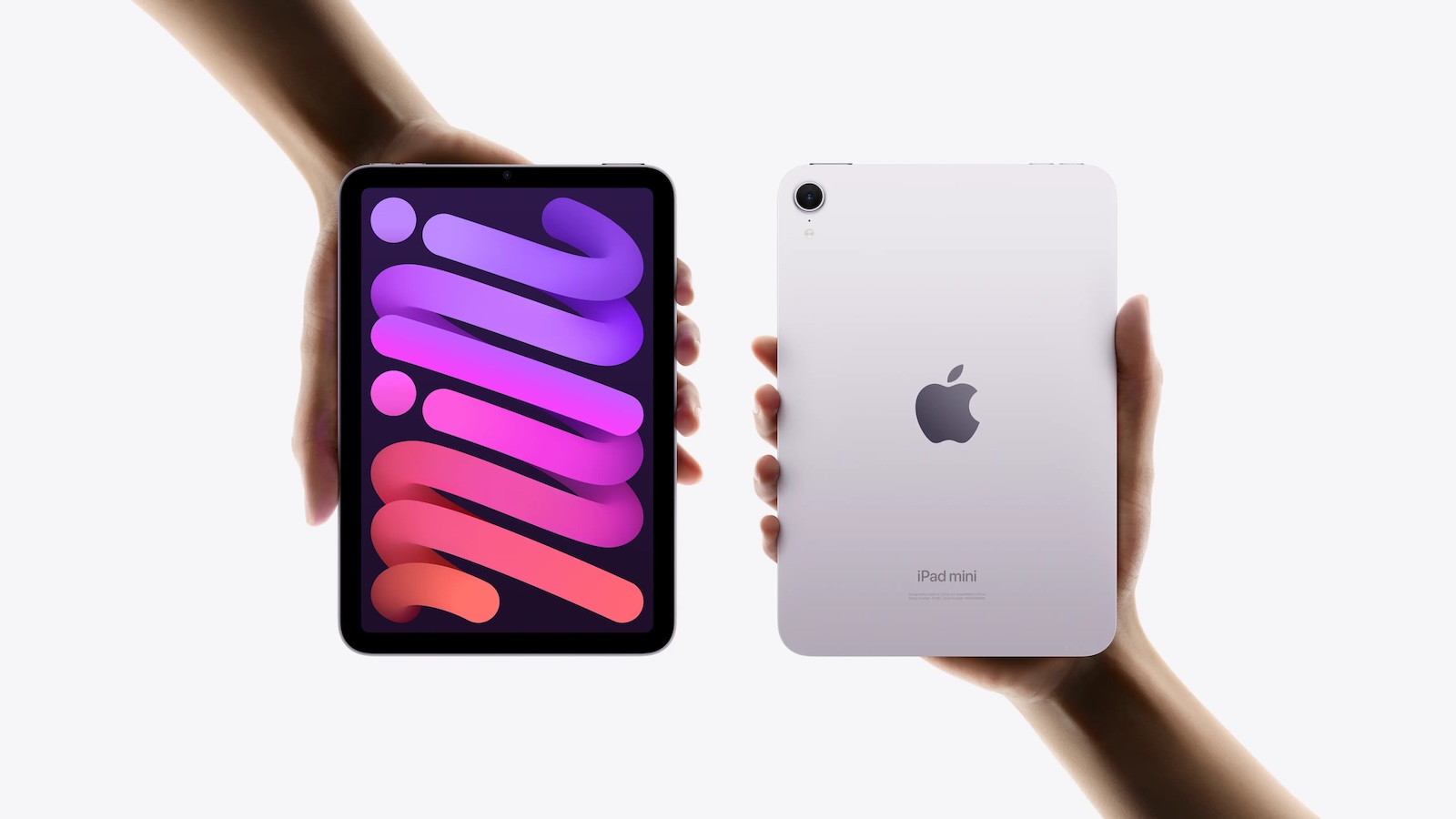
ipad-mini-7-purple-hands.jpg

According to research firm Omdia, the ‌‌iPad mini‌‌ is expected to adopt an OLED display in 2027. However, Korea's ET News and ZDNET Korea have both suggested that the iPad mini will be updated with an OLED display in 2026. Bloomberg has also said the update could come as soon as this year.

The most recent word on the subject comes from Weibo-based leaker Instant Digital, who claims the OLED iPad mini will be launched in the... Click here to read rest of article

Article Link: OLED iPad Mini: Release Date, Pricing, and What to Expect

Needs an M-Series Chip.
 
Register on MacRumors! This sidebar will go away, and you'll see fewer ads.