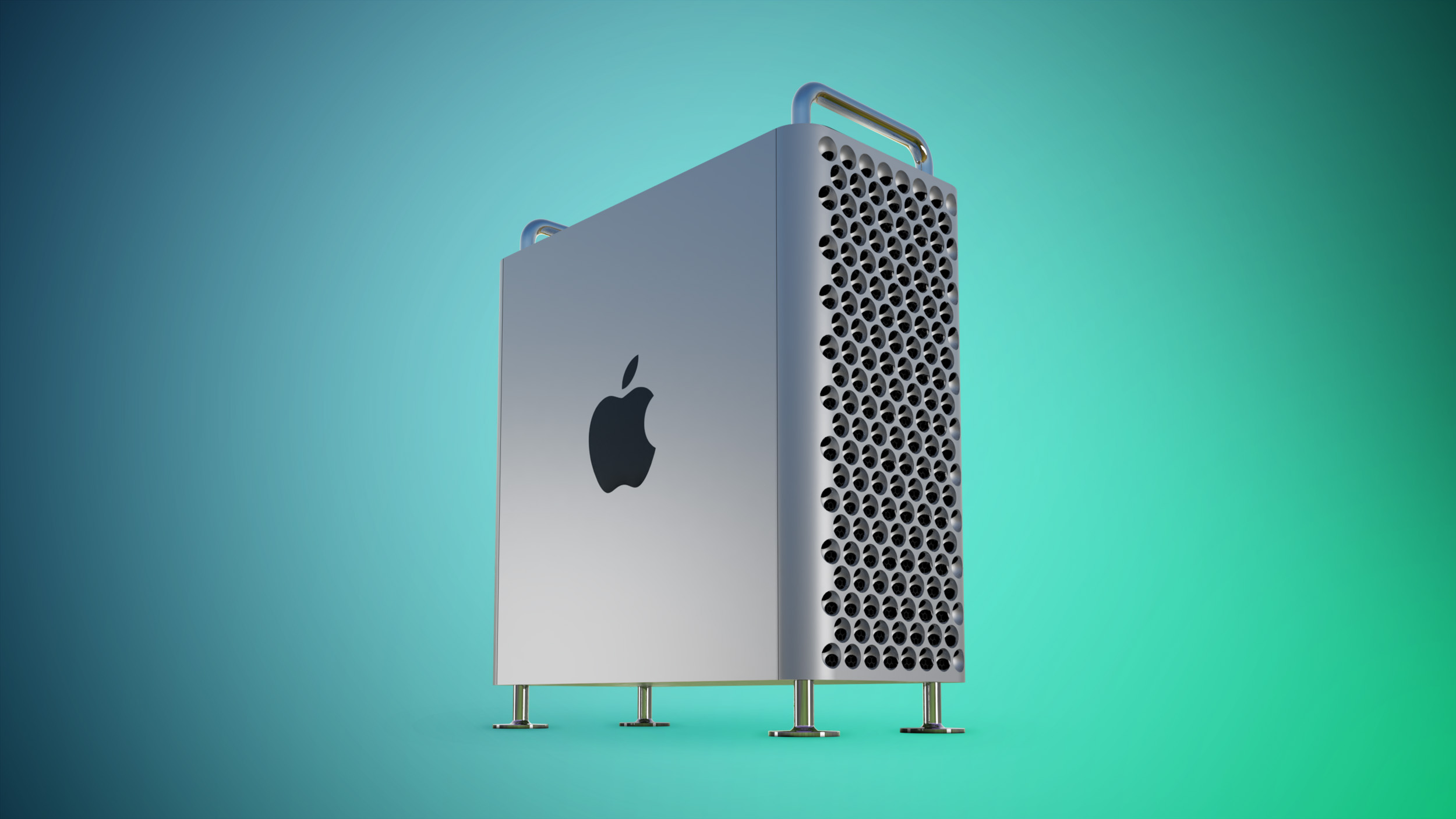
"to address certain uses..." Let your imaginations run wild. What do you think the specs of this Mac Pro would've been?
Probably just a routine spec update. CPU upgraded to whatever the then-latest version of the Xeon-W was. Maybe PCIe Gen 4. Wheels 2.0 now $1000 for a pack of 3. Nothing to get excited about...
The "certain uses" were most likely users with specialist PCIe cards (see next comment).
Alas, Apple screwed us all with the insult that was the Apple Silicon Mac Pro and its eight PCIe slots for...storage.
It wasn't really a successor to the 2019 Mac Pro - calling it that was probably Apple's big mistake. It was really a "Mac Studio PCIe edition". I suspect it was aimed at users who still depended on specialist "legacy" PCIe cards - storage was only one option, but more likely candidates would be things like accelerators/audio interfaces for ProTools, video capture or specialist networking cards... The 2023 MP gave them another few years to move to Thunderbolt options. The PCIe capability may have been pathetic by 2019 MP standards, but it was better than (expensive) Thunderbolt PCIe enclosures.
There's a list of Thunderbolt supported cards on Sonnet's website, which is indicative of the sort of cards people need(ed) to plug into Macs - mainly, I suspect, because
they already had the cards and weren't ready to switch workflow:
Apple, once again, does its power users dirty. But what do they care?
Well, users have had since 2012 (when they started to neglect the classic Mac Pro and even discontinued it in the EU rasther than fit a fan guard to meet a new reg) to get that message.
Actual pro users need to know that they'll still be able to buy something up-to-date but still backwards-compatible in year 3 of a 5 year project - not have some massive paradigm shift (like the Trashcan) forced on them.
Its pretty clear that they planned to replace the trashcan with the iMac Pro in 2017 and were stopped by some internal schism or a revolt by key partners/customers. Then they kinda went mad with the 2019 and priced out half of their Mac Pro customer base. All they needed to do in 2017 (or before that, as soon as they saw that the trashcan was a dead end) was pick up the phone to Foxconn and have a container-load of "official Hackintoshes" in nice premium-looking cases on the next ship from China - which would have kept the Mac Pro ticking over until Apple Silicon changed the story.
The really bizarre thing was that they bothered to develop things like the MPX slots and stupidly expensive 3D milled front panels/dust magnets when, by 2019, they
must have known that Apple Silicon was in the pipeline.
The problem with the whole late Intel Mac era is that Apple were just making x86 PC clones with nice trackpads and a built in MacOS security dongle. Ultimately, the 2019 MP was just an implementation of Intel's new-generation Xeon W processors. If you needed anything like that level of power there was a vast choice of generic PC hardware that could be combined to make a system tailor made to your needs - unless you were locked in to a bit of Mac-only software. What was telling was that all of the benchmark claims on Apple's website were comparing with 6-year-old Trashcans or iMac Pros rather than any contemporary PC hardware.
Apple Silicon changed that and gave Apple something that would distinguish its tablets, laptops and SFF systems (which account for the vast majority of Apple's non-iPhone hardware sales) from the competition - and also solved many of the problems with the Trashcan concept. The price of that was that when it came to making modular PCIe tower workstations, Apple Silicon was as much use as a chocolate teapot.
The biggest issue with the Apple silicon Mac Pro is lack of PCIe lanes, no PCie GPU support or upgradable RAM.
...but the biggest
advantages of Apple Silicon are its power-efficient integrated GPU/NPU/Media engine sharing unified, high-bandwidth LPDDR RAM mounted on the package for the shortest possible traces - and it's shedload of on-die USB4/TB interfaces. That's what gives MacBooks and Minis the edge over the competition, that's
why people have been buying Minis and Studios for local LLM work where 64-128G of unified RAM beats having a ton of separate system RAM but liimited VRAM on the dGPU. Apple need pro software developers to optimise for Metal and Apple Silicon GPU/NPU so that the benefits trickle down to the MBP, Mini and Studio.
Let's say Apple gave people the "faster horses" they'd been asking for - an Apple Silicon Mac Pro with DDR5 RAM and support for the latest NVIDIA PCIe GPUs (even when the rest of the industry is swimming towards more Studio-like machines) then it's performance on things like LLM training and 3D would be... well, no better than the same NVIDIA GPUs in a Threadripper/Epyc box that cost half as much
and could run legacy x86 code. Not to mention that the only way that Apple Silicon could deliver that RAM and PCIe bandwidth without Apple developing a whole new die was via something like the Extreme which meant quadding-up the iGPUs, NPUs and media engines
that you weren't going to use. Meanwhile the legendary ARM power savings aren't really going to matter once you plug in a brace of NVIDIA space heaters.
The 2023 Mac Pro - outside the niche that want to keep their ProTools accelerators or Fibrechannel cards for another 3 years - was basically Apple coughing, looking at its watch and hoping they don't have to resort to offering to get people their coats.